


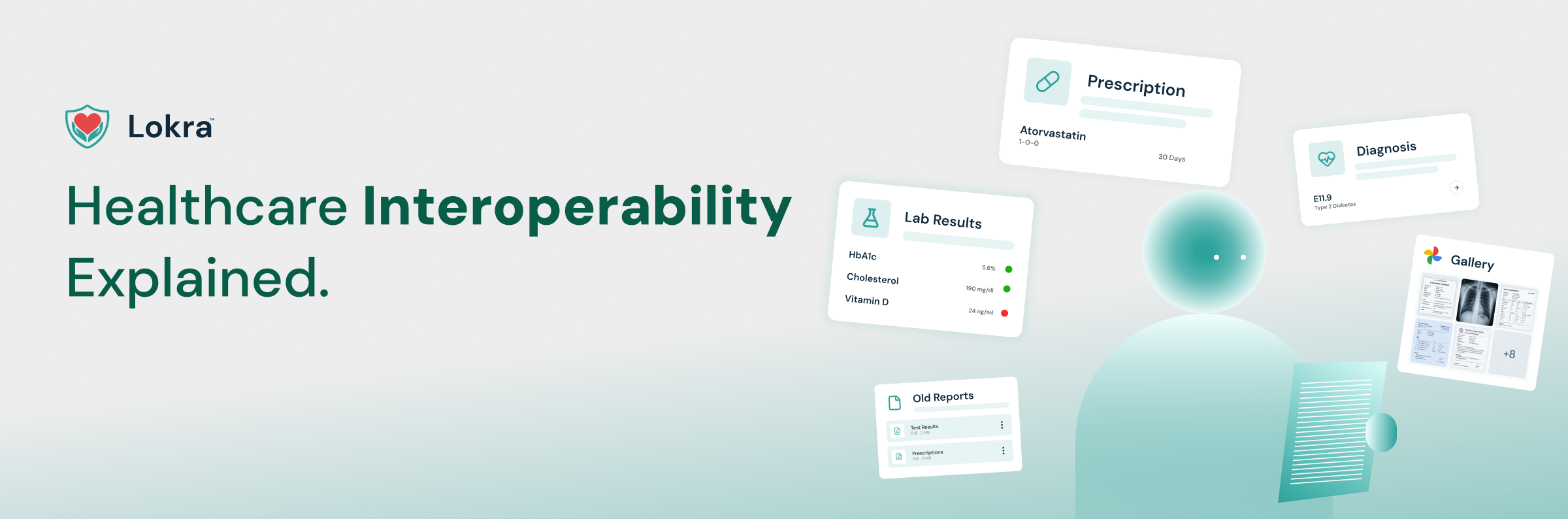
A patient may receive a test at one facility, consult a specialist at another, and continue follow-up with a local clinic. Each organization may use a different information system. When those systems cannot exchange or interpret information effectively, healthcare teams may have to request records manually, re-enter data, or work with an incomplete view of the patient’s history.
Healthcare interoperability is the ability of different systems and organizations to exchange information and use it meaningfully. One important standard supporting this work is HL7 FHIR, which provides a modern framework for representing and exchanging healthcare information.
FHIR can make integration work more consistent, but it is not a magic switch that connects every system automatically. Successful interoperability also depends on implementation choices, data quality, patient identity, permissions, security, terminology, and the workflows in which information is used.
What is healthcare interoperability?
Interoperability goes beyond moving a file from one system to another. The receiving system and its users need to understand what the information means, where it came from, and whether it is appropriate to use in a particular context.
For example, a laboratory report might be available as a PDF. That document can be useful to a clinician, but exchanging structured information—such as the patient, test, result, unit, reference range, and date—may also support search, display, and other workflows. The right format depends on the use case; a document and structured data can serve complementary purposes.
Organizations often discuss interoperability in several layers: the ability to transmit data, the ability to interpret its structure and meaning, and the ability to use it within clinical and operational workflows. Technology is essential, but agreements about meaning, access, and responsibility matter just as much.
What is HL7 FHIR?
FHIR stands for Fast Healthcare Interoperability Resources. It is a healthcare data exchange standard published by HL7. FHIR defines a way to represent common healthcare concepts as resources and exchange them through defined interfaces and implementation patterns.
Examples of FHIR resources include Patient, Practitioner, Observation, DiagnosticReport, MedicationRequest, and Encounter. Each resource has a defined structure. Implementations may use APIs to request or exchange resources, depending on the system and the implementation guide being followed.
The official FHIR specification describes the standard as a framework for exchanging healthcare information electronically. It is designed to be implementable using contemporary approaches while preserving a structured model for health information.
A simple example: sharing a diagnostic report
Imagine a patient has a laboratory test at Facility A and later visits a clinician at Facility B. If both systems support a compatible integration, the second system may be able to request relevant information through an agreed exchange process, subject to authorization and the capabilities of both systems.
- The source system records the patient, test request, result, and relevant metadata.
- The source makes appropriate information available through an agreed interface and access policy.
- The receiving system requests or receives the information using the supported exchange workflow.
- The receiving system checks the data structure, identifiers, permissions, and relevant implementation rules.
- The information is presented to the authorized user with enough context to understand its source and timing.
This is an illustrative flow, not a guarantee that every FHIR-enabled system can exchange every resource. The actual interaction depends on the supported FHIR version, profiles, API capabilities, authentication, authorization, and local agreements.
What FHIR can help with—and what it cannot solve alone
Where FHIR can help
- Provide shared structures for common healthcare information.
- Support API-based exchange between compatible systems.
- Reduce the need to invent a completely different data model for every integration.
- Make implementation requirements more explicit through profiles and implementation guides.
- Support a range of clinical, administrative, diagnostic, and workflow use cases.
What still needs to be designed
- Patient identity: systems must determine whether records refer to the same person using appropriate identity-matching processes.
- Consent and authorization: access must follow applicable permissions, policies, and legal requirements.
- Data quality: exchanged information may still be incomplete, outdated, duplicated, or inconsistent.
- Terminology: codes, units, and clinical concepts need compatible interpretation.
- Workflow: clinicians need to know when and how to use incoming information.
- Security and auditability: systems need appropriate authentication, access control, monitoring, and traceability.
- Version and profile compatibility: two systems may implement different versions or constrain resources differently.
A system can use FHIR and still have integration gaps. The important question is not only “Does it support FHIR?” but also “Which version, resources, profiles, interactions, and workflows does it support, and how have these been tested?”
A practical interoperability checklist for healthcare organizations
Before beginning an integration, bring clinical, technical, security, and operational stakeholders together. A useful discovery checklist includes:
- Use case: what problem should the exchange solve, and who will use the information?
- Data scope: which resources, documents, fields, and historical periods are required?
- Standards: which FHIR version, profiles, terminology systems, and implementation guides apply?
- Identity: how will patient matching and duplicate handling work?
- Access: who is allowed to request, view, or update information, and under what conditions?
- Data quality: how will missing values, inconsistent units, and outdated information be handled?
- Operations: how will failures, retries, monitoring, and support responsibilities be managed?
- Testing: how will teams validate conformance, security, and real workflow outcomes?
- Governance: who owns the integration, approves changes, and reviews incidents?
- User experience: how will staff identify the source, timestamp, and status of received information?
Start with a narrow, valuable use case and test it with realistic, non-production data. Expand only when the workflow, security controls, data quality, and operational responsibilities are understood.
Why interoperability matters in low-connectivity environments
In environments where network access is inconsistent, data exchange needs to be paired with a clear strategy for availability and synchronization. A system may be able to exchange data through FHIR when connected, but the standard itself does not guarantee offline functionality.
Teams should separately define which information needs to be available locally, how the local copy is protected, how users see whether data is current, and how changes are synchronized when connectivity returns. They should also plan for stale information and conflicts between updates made in different places.
The key design principle is to avoid hiding uncertainty. If a clinician is viewing a locally available record that has not been refreshed, the interface should make that clear. If a transaction must reach a server before it is complete, the system should not present it as finalized before confirmation.
How Lokra fits into the conversation
Lokra can use this topic to explain its approach to health-record continuity and the role its products may play alongside existing systems. Keep the message specific: describe the workflows and integrations that are actually supported, and distinguish current capabilities from planned work or conceptual examples.
For organizations exploring partnership or integration, the most useful next step is a conversation about the real environment: the systems in use, connectivity constraints, information that needs to move, user roles, consent requirements, and operational support. Those details determine whether a proposed interoperability approach will work in practice.
Discuss healthcare data continuity with Lokra
If your organization is exploring connected health records or continuity across care settings, contact Lokra to discuss your requirements and integration context.
Contact Lokra about partnerships →Frequently asked questions
What is HL7 FHIR in healthcare?
HL7 FHIR is a standard for representing and exchanging healthcare information electronically. It defines resources and exchange patterns that implementations can use to support compatible data exchange.
Does FHIR automatically make two systems interoperable?
No. Systems need compatible versions, profiles, data definitions, interfaces, identity processes, permissions, and workflows. Implementations need to be tested together.
What is the role of APIs in healthcare interoperability?
APIs can provide defined ways for systems to request or exchange information. The API must be implemented securely and consistently with the data standards and permissions used by participating systems.
Does FHIR provide offline access?
FHIR defines healthcare information exchange; it does not by itself guarantee that an application works offline. Offline access and synchronization need to be designed and implemented separately.
Should an organization use FHIR R4 or another version?
The appropriate version depends on the project, jurisdiction, implementation guide, partner systems, and existing requirements. Teams should confirm compatibility with their integration partners rather than selecting a version in isolation.